
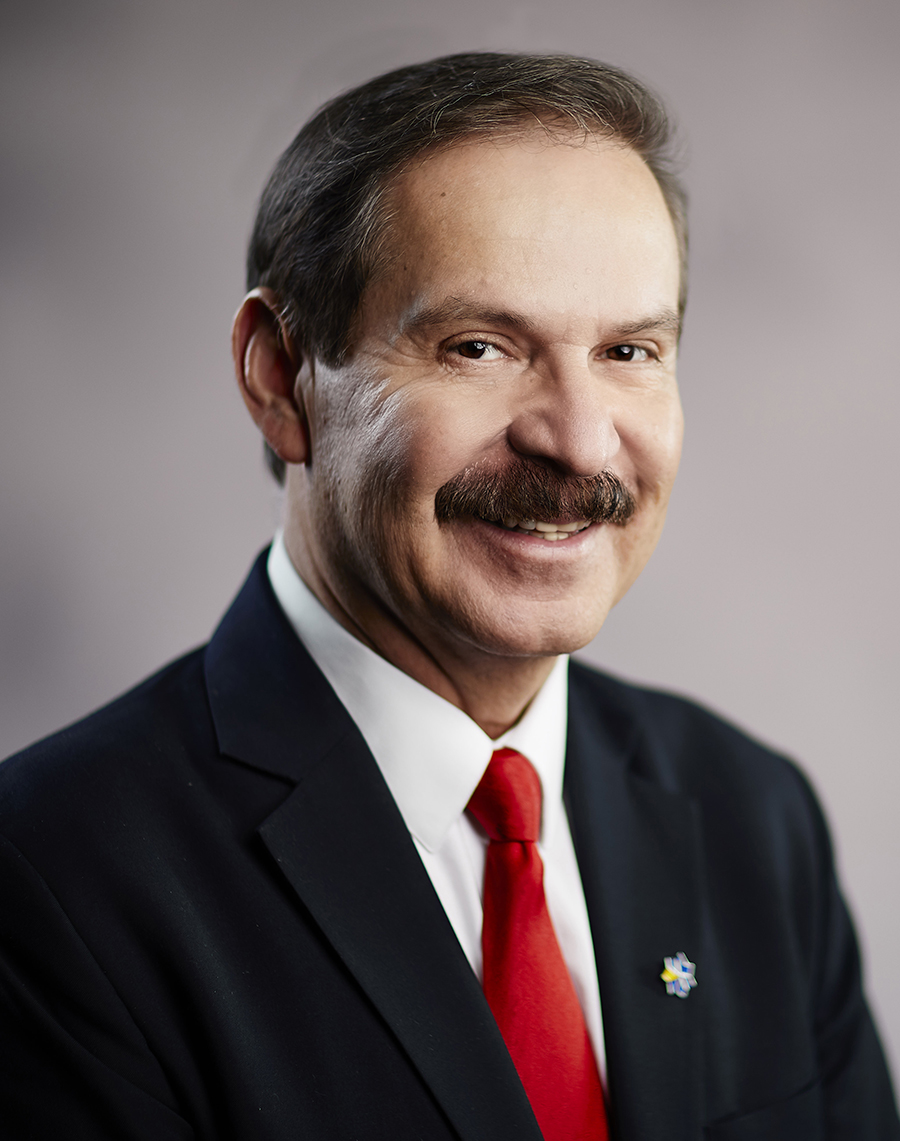
CSN Foundation 2012 Legacy of Achievement Gala Raised Thousands of Dollars for CSN Students

The College of Southern Nevada Foundation conducted one of the most significant fund raisers of  the year in Nevada higher education, the 2012 Legacy of Achievement Gala, on Saturday, May 12, at the Rio All-Suite Hotel & Casino.

 More than 500 guests and over a dozen community partners, including NV Energy and Caesars Entertainment, supported the event to raise more than $300,000 for CSN scholarships and programs.            

The CSN Foundation organizes the gala each year to raise funds and honor community leaders. The Legacy of Achievement program was initiated in 2007 and the annual gala has raised almost $2 million for student scholarships and programs at the state’s largest and most diverse higher education institution.

This year, the Foundation honored Henderson Municipal Court Judge Diana D. Hampton, Western Zone President for American Residential Services Kenneth D. Goodrich, CSN Fine Arts Department Chair Richard McGee, Ph.D., and Sunbelt Communications Executive Vice President of News Robert “Bob” Stoldal.

Recipients, who will have an endowed scholarship at CSN in each of their names, were selected by trustees based on the overall and lasting impact of their contributions locally, statewide and nationally.

The CSN May Chronicle

Greetings!  As this academic year winds down, there is much to report to you in many areas of the college.      

Achieving the Dream

We have announced that CSN has become an Achieving the Dream institution with CSN Professor Janice Glasper leading our team.  Learn more about ATD by visiting its website here

ATD focuses on improving student success, including completions of certificates and degrees, among all students and especially underrepresented minorities.        

As an Achieving the Dream institution, CSN is already receiving invitations to apply for foundation and corporate grants.  This is an encouraging dimension of our participation in ATD. 

Transfer Task Force

CSN and UNLV have agreed to form a Transfer Task Force to carry out a specific charge that may also be replicated among other institutions in the state.  Here’s the charge: 

A major resource of the State of Nevada is its diverse system of higher education within which students may seek and obtain advanced education for their personal and professional improvement.

While some Nevada students begin and complete their education at one institution, many find it necessary to take courses at multiple colleges and universities.  Some take transferable college level courses while still enrolled in high school.  Because students move so freely through our system, they often miss key services to help them proceed efficiently toward their career goals.  They may not carefully monitor which classes articulate with bachelor’s degree programs, and of course as they take new classes, they may change their career objectives several times en route to a bachelor’s degree. In some cases,lack of understanding of application requirements, how to apply, and how to secure financial aid can create barriers to success.  Recent cuts have also created critical service gaps that may complicate transfer and must also be addressed.  The process of reverse transfer is also  poorly understood by students “swirling” through different institutions.

With these challenges in mind, CSN and UNLV will form a Task Force on Transfer to examine ways to improve transfer mobility, increase student satisfaction and degree completion, reduce the costs of their education, and improve the efficient use of tax/fee dollars.  

The charge to the task force will proceed in phases as follows:
·        To gather inter-institutional data on transfer or develop the data resources needed to gather the data using our new student information system and data warehouse tools.
·        To analyze the data in a detailed way to understand transfer patterns, inefficiencies and success.
·        To examine transfer policies and practices in other states and recommend best practices for institutions and students in Nevada.
·        To develop a comprehensive plan addressing weak links to improve transfer success and efficiency, including identification of the resources needed to effect the changes.
·        To form an implementation committee to track our progress and ensure a high degree of institutional collaboration in the service of our students.

The results of the task force will be published as each phase is completed and can be used to improve transfer throughout the NSHE.  Our overall goal is to provide a high quality educational experience for transfer students as well as native students, and to increase our graduation success in Southern Nevada, and our state.


I know that transfer issues of all kinds have impeded students and frustrated faculty.  Now we have a chance to address the issues with a review of best national practices. 

Faculty Election Results: 

Congratulations to Dr. Darin Dockstader,  the new Faculty Senate chair-elect! 

Congratulations to new and continuing department chairs elected this spring. These terms are effective fall 2012 to spring 2015: 

Business Administration:  Clarissa Cota

Computing and Information Technology:  Margaret Taylor

Dental Sciences, Diagnostic Evaluation and Rehabilitation Services:  Jim Godin

English:  Levia Hayes

Health Relate Professions:  Cassie Gentry

Social Sciences:  John Hollitz 

Salary Schedule Review

Carolyn Collins and John Scarborough are CSN’s representatives on the Salary Schedule Review Committee.  They are doing an awesome job for us.  We should see a preliminary report from them during fall Convocation. 

Regional Planning Authority

For the past several months, CSN has participated with other community organizations on the creation of a Regional Planning Authority to implement the Nevada Economic Development Plan.  Many thanks to Rebecca-Metty Burns and Constance Brooks for their work on this new direction for southern Nevada.  

The RDA will serve as a regional organization focused on strengthening local economic development.  CSN is a stakeholder in this process and I am part of the steering committee comprised of city, county and chamber officials. This is a great opportunity for local and state government, education and community officials to work collaboratively with the private sector on such issues as economic diversification and workforce development with a focus on Southern Nevada. 

Budget Priorities

Over the next few months, the Board of Regents will establish budget priorities for the 2013 legislative session.   The presidents have recommended funding salaries at the full base and eliminating furloughs for all employees as top priorities.  We are also recommending that the state improve funding for benefits and provide plan options. 

In addition, we are recommending the new funding formula become the NSHE and legislative compact. 

ASCSN Elections:

Student government completed its elections in April. Congratulations to the new 2012-13 officers:

President: Travis Brown
Vice President: Antonio Guerrero
Secretary: Charles Winters
Treasurer: Julie Ogulnick
Cheyenne Senator: Cecilia Arroyo Arias, Christopher Herrera, and Nailah Gantt
W. Charleston Senator: Jonathan “Streetz” Paya, Michelle Tewes, James Garrett, and Steven Cohen
Extension Senator: Jesus Lopez Huizar

Phi Theta Kappa

Congratulations to CSN student and PTK member Gail San Diego, who was elected to be the International Vice President of Division IV, one of the highest ranking positions within the honors society at the annual convention in April in Nashville, TN. 

Formula Study

Since December, the Legislature’s study committee on higher education funding has met monthly to consider a new and more equitable funding formula.  CSN has supported the Chancellor’s plan to revise the formula with an emphasis on course completions described in campus meetings held earlier this spring.  I have kept my blog up to date with the latest information on the formula and how CSN compares.    Committee chairman Steven Horsford has formed two subcommittees:  one to examine the alternative formula and the other to consider local funding and governance.  Should there be developments on the formula over the summer months, we’ll post them to our web page and my blog and report on them during Convocation. 

Remember our Reflection of Success Awards dinner and program is on Friday, May 18 at Texas Station.  It’s a chance to recognize our wonderful faculty and staff. RSVP at rsvp@csn.edu

The CSN Foundation Legacy of Achievement Gala is May 12 at the Rio. More information is available at www.csn.edu/foundation.

Also, remember Commencement is Monday, May 21 at 6 p.m. at the Thomas & Mack Center at UNLV.

 Emergency Management and Preparedness 

On April 17-19, 2012, CSN sent a team to a FEMA sponsored training, Multi-Hazard Emergency Planning for Higher Education.  The team, which included Darryl Caraballo, Carlo Dacumos, Greg Gammon, Brad Gruner, and Luis Tristan received first hand training regarding:  1) phases of emergency management; 2) identifying hazards and using a risk assessment process; 3) response using Incident Command System (ICS), and setting up an Emergency Operation Center; 4) partnering with our community; 5) developing plans; training and testing the plans; and 6) engaging the campus community.    

Over the past year, we have been actively engaged in developing CSN’s Emergency Operations Plan (EOP) and various aspects of emergency preparedness for CSN—among them the Emergency Management and Preparedness Guide which was launched to the college community in Fall 2011.  The Guide can be located on the CSN website http://www.csn.edu/pages/3947.asp.  Over the coming months you will continue to hear about efforts to better prepare CSN in the case of an emergency and the role you play in this all-college priority.   

During  Convocation  in August, an overview of what we have accomplished to date will be presented, and training opportunities will be provided during the CAPE schedule to communicate the Emergency Operations Plan, faculty, staff, and student roles and responsibilities in the event of an emergency; and lots of key information that you will want to have. 

Should you have any questions, please feel free to contact the Office of the Senior Vice President for Finance & Administration, Patty Charlton at 651-5667.

Questions from Faculty and Staff Members: 

“How likely is the chancellor’s funding formula proposal to succeed and be implemented by the state?”

I believe there is a good chance that the revised funding formula will be adopted and implemented according to the schedule that Chancellor has outlined.  My meetings with legislators and regents have reinforced the favorable elements of the new formula, and have been encouraging.  We must be vigilant, however, because this is a long process, and changes could occur along the way.  I’ve become very leery of proposed changes because they negatively impact CSN. 

 “How much did CSN pay to join Achieving the Dream and what does that provide that we cannot do ourselves?”

As part of CSN’s selection to join Achieving the Dream, the college pays $75,000 per year for membership. For this fee, CSN will receive a leadership and data coach that will each visit the institution multiple times a year to work with us in our first year of planning and review and then in our subsequent years of intervention and review. We will receive assistance with data analysis, access to best practices for methodologies to improve student success and conference registrations. Indirectly, CSN receives the prestige of affiliating with like institutions and additional opportunities to seek alternative funds to support our initiatives.

Achieving the Dream will help us improve student success opportunities and diminish achievement gaps, faster than we could ourselves.  In addition, the mileage Nevada will receives from these improved practices and the impact we hope that they will have on students will help our state and local economy as we move better prepared, critically thinking and highly skilled students into the workforce.

“Why did CSN want to be a designated Achieving the Dream Institution?”

In the 2010-2017 CSN strategic plan, also known as Enterprise 10-17, student success is a common theme through the core themes of access, quality, and diversity.  Examples of CSN goals and achievement indicators targeting student success are:

  • Encourage students to complete degrees in 3 years, certificates in 2 years;
  • Increase the number of declared majors who graduate;
  • Encourage students to take remedial work in first 30 credits; and
  • Any department offering remedial education will show increased student success. 

“How did CSN become a designated Achieving the Dream Institution?”   

CSN initially applied for ATD designation in 2010.  Our application was rejected and we were encouraged to reapply.  We reapplied in December 2011 and were accepted into the fall 2012 cohort of colleges.  CSN is the first community college in Nevada to apply and be accepted as an ATD institution. The announcement was embargoed, meaning we were unable to say announce this, until the national organization released the information to the news media.  

“How does Achieving the Dream affect the average faculty member?” 

For the first year, most impacts will be felt in institutional research and student affairs.  But long term our success with Achieving the Dream will be an institutional effort involving faculty, staff and students.   The ATD coaches will be working with a variety of constituents to evaluate the college’s practices over the next year and create a plan going forward. Specific interventions will be developed at this time that may or may not impact each individual faculty.  The important point is that this will be a collaborative process and you will be able to provide input either through faculty senate representation, communicating directly with core team leaders or other communication mechanisms that will be developed. 

Convocation will take place August 20 at Texas Station.  Thanks to your input in our survey last year, we have modified the program to target a number of reports during a short two-hour session. Look for the email invitation, requesting your RSVP in the coming weeks.     

 –Mike Richards

More information about CSN's selection to join Achieving the Dream

Greetings!

          On Friday, we announced that CSN has been selected to join an elite group of colleges as part of the Achieving the Dream National Reform Network.

             Achieving the Dream is the nation’s most comprehensive non-governmental reform network for student success in higher education. The organization strives to improve member colleges’ practices and procedures to close achievement gaps and augment student retention, persistence and completion rates.

             This means that CSN will have the best coaching and assistance available in the nation to ensure the students who walk through our doors obtain a quality and meaningful education that translates into personal and professional success. On Friday, we gave a broad overview about Achieving the Dream. This link provides a more detailed outline of what we can expect during the first year of planning and the next two years when we implement the first and second rounds of interventions as part of Achieving the Dream. 

            Dr. John Nixon, who recently retired as President of Mt. San Antonio College in California, will serve as our leadership coach. He has over 35 years of experience working with community colleges, including overseeing policy and management of California’s largest single-campus community college district. Dr. Ken Gonzalez, a national expert and researcher on institutional effectiveness in higher education, will be our data coach. Both will guide us to create institution-wide student success initiatives. 

A couple of examples of how Achieving the Dream has impacted other community colleges.

  • At Galveston College in Texas, officials increased developmental math success rates from 21% in fall 2006 to 58.6% in fall 2010. This remarkable improvement is associated with changes to the developmental math curriculum, including increased contact hours and use of MyMathLab software. These interventions have been scaled to reach 100% of developmental math students and 18.8% of all students.
  • At Community College of Vermont, located in Montpelier, they increased first-time, fall-to-fall retention rates for first-time-in-college students from 38% in 2006 to 41% in 2009. The improvement is associated with an initiative called the Dimensions First intervention, a required first semester seminar that helps students to build strong information literacy and critical thinking skills, teaches them how to engage in the academic community, and provides a space for goal-setting and reflection. Dimensions First has been scaled to reach 35% of first-time-in-college students and 6% of all students.
  • At Delaware County Community College in Media, Pennsylvania, they increased fall-to-spring retention from 68% in 2007 to 73% in 2011. They did this by using a combination of interventions: English conferencing, Supplemental Instruction, JumpStart Math, Academy for College Excellence, Reading/counselor pairings, new student orientation and mentoring that in combination have been scaled to reach 31% of all students.

As part of Achieving the Dream, CSN has a core team that includes Professor Janice Glasper, incoming Faculty Senate Chair Dr. Charles Milne, Institutional Research Director John Bearce, Senior Vice President of Finance & Facilities Patty Charlton, Vice President of Academic Affairs Dr. Darren Divine, Vice President of Student Affairs Dr. Santos Martinez, Associate Vice President of Academic Affairs Dr. Hyla Winters and me. Many others will also be involved. We will be looking at a variety of practices in student services and academic affairs. Working with the coaches, assessing our weaknesses and fixing these practices will require broad participation from a variety of faculty and staff. This must be an institutional effort. 

We are embarking upon a very exciting journey for CSN that will help us make more effective improvements, faster than we could on our own. I look forward working with you all during this transformative process.

We will hear more about this great initiative at Fall Convocation on Aug. 20 at Texas Station. Mark your calendars. 

Sincerely, 

Michael Richards, Ph.D.
President, CSN


CSN selected into the Achieving the Dream National Reform Network (CSN Press Release)

LAS VEGAS (April 27, 2012) – The nation’s most comprehensive non-governmental reform network for student success in higher education has selected CSN to join its national reform network, CSN President Dr. Michael Richards announced today.

CSN joins an elite group of colleges in June as part of Achieving the Dream and will begin immediately to identify strategies to close achievement gaps and increase student retention, persistence, and completion rates.

“As an Achieving the Dream institution, we will have access to the best practices in the nation, coaches and data analysts that will help our students succeed and improve opportunities for the entire state,” Richards said. “With the help of the Achieving the Dream, we will go farther, faster than we ever could on our own.” 

As an Achieving the Dream institution, CSN will develop and implement research-based policies and practices based on quantitative and qualitative analyses of its institutional strengths, problem areas, and achievement gaps. CSN is committed to assessing the effectiveness of these policies and practices, institutionalizing the approaches that prove successful, and sharing the findings widely. 

Through Achieving the Dream, CSN will have the opportunity to learn from other Achieving the Dream institutions and receive assistance from experienced practitioners in building a culture of evidence campus-wide, using data to identify problems, setting priorities, and measuring progress toward increasing student success. 

 “The work of closing achievement gaps and improving student success is extremely difficult and critically important,” said Beverly Fletcher, Senior Director of Organizational Development and Change for Achieving the Dream. “Being an Achieving the Dream institution takes courage, discipline, and a tenacious institution-wide commitment to student success and equity. CSN should be applauded for helping tackle one of society’s most daunting challenges: success for more college students.” 

The Achieving the Dream Model

Each college commits to the Achieving the Dream Student-Centered Model of Institutional Improvement. Based on four principles, the Model frames the overall work of helping more students, particularly low-income students and students of color, stay in school and earn a college certificate or degree. Each college will approach the work differently, but Achieving the Dream’s five-step process will provide practical guidelines for helping keep the focus where it belongs and building momentum over time. Throughout the process, Achieving the Dream Coaches will offer customized support and help each college’s core team implement data-informed programs and policies that build long-term, institution-wide commitment to student success. Learn more about the Model here.

Achieving the Dream is a national nonprofit leading the nation’s most comprehensive non-governmental reform network for student success in higher education history. The Achieving the Dream National Reform Network, including nearly 200 institutions, more than 100 coaches and advisors, and 15 state policy teams – working throughout 32 states and the District of Columbia – helps 3.75 million community college students have a better chance of realizing greater economic opportunity and achieving their dreams.

About CSN: Founded in 1971, the College of Southern Nevada (csn.edu) is the state’s largest and most ethnically diverse higher education institution. CSN offers more than 200 degree and certificate options in more than 130 areas of study, including 30 degree and certificate programs available entirely online. Students create flexible, personalized schedules, including day, evening, and weekend classes taught on three main campuses and multiple locations throughout Southern Nevada. CSN — Your future starts here.


###


Funding Formula Comparison

As the discussion on how to allocate state funds to Nevada’s universities and colleges continues, I would like to share a comparison of the state funding per student under the current formula and under the chancellor’s proposed model. Click on the graphic to enlarge it on your screen.


New NSHE Funding Model

The chancellor’s proposed funding formula, discussed in this morning’s Review-Journal in an article by Richard Lake, is a good start to creating a transparent and equitable way to distribute state support to our colleges and universities.

CSN students have historically been funded at substandard levels compared to their peers at other community colleges. We are gratified that the model in its current iteration strives to address this large funding gap that has persisted and grown over the last two decades. Looking forward, this will create a fair and equitable funding system for all of Nevada’s higher education institutions, the likes of which we have never experienced.

In particular, I appreciate that this formula recognizes the different missions of the state’s seven teaching institutions. The model rewards colleges and universities if their students complete courses and provides incentives for us to fulfill state and national graduation goals. Most importantly, the proposal allows each college and university to retain fees and tuition so that its students will benefit from their investment in their education.

March Chronicle

The CSN Chronicle 

Greetings and welcome to The CSN Chronicle for March 2012.  For a year when the Legislature is not in session, the spring semester is unusually busy with studies, events and policy changes that I want to share with you.      

Fall 2012 Registration Changes 

Three major policy/protocol changes have been announced that may impact student enrollment for fall 2012 semester classes.  I would ask that all faculty and staff understand these changes so that we may all work to help students experience a smooth enrollment process and a successful fall semester. 

1.  Payment due date is June 1:

Early registration begins May 1 and the payment due date for students who register early for fall 2012 classes is June 1. Payment or payment arrangements (whether paying out of pocket or with financial aid) must be made by this deadline or students’ enrollment may be canceled. Registration re-opens for all students on June 4, after which time payment is due at 11:59 p.m. on the day of registration. 

The use of this “rolling” enrollment cancellation process will help ensure CSN does not shutdown the entire registration system for all NSHE institutions as we did last fall.   

The following steps will help students protect their enrollment from cancelation:

· Complete the Free Application for Federal Student Aid (FAFSA) form before May 30;
· Pay the balance due before 11:59 p.m. on June 1; or
· Sign up for a payment plan online via MyCSN and pay the minimum amount due by 11:59 p.m. on June 1, (or do so in person at a campus cashier’s office during regular business hours).                       

2.  Residency application materials are due Aug. 1, 2012:

To apply for in-state residency for the fall 2012 semester, students submitting residency applications must turn in their complete application with all supporting documentation no later than Aug. 1, 2012.           

3.  Changes affecting students who do not have a high school diploma or its equivalent:

Incoming students seeking a degree or certificate of achievement from CSN must have a high school diploma or its equivalent, to be admitted to an academic program at CSN and to be considered for financial aid. 

An incoming student without a high school diploma or its equivalent may apply for admission to CSN as a degree-seeking student under alternative criteria but will not be eligible for financial aid. Incoming students may be admitted under alternative criteria by satisfying one of the following requirements: 

         Placement testing scores sufficient for entry into ENG 100 and Math 095 or higher; or

         Transfer credits equivalent to NSHE’s ENG 100 and Math 095 with grades of “C” or better   

          from another accredited college or university; and have good standing at any previously

          attended institutions, including but not limited to, records of disciplinary action. 

Subject to the approval of appropriate high school and college officials, junior and senior high school students who are at least 16 years old may be admitted and enrolled at CSN. 

Due to changes in federal regulations, students must have a high school diploma or its equivalent to be considered for financial aid. 

Current degree-seeking CSN students without a high school diploma or its equivalent receiving financial aid (including students satisfying the Ability-to-Benefit requirement) will be allowed to complete that program with financial aid assistance but will not be able to change their declared majors after June 30, 2012 without first earning their high school diplomas or its equivalent. 

Therefore, current students who do not have a high school diploma or its equivalent should verify that their declared major/degree programs in the MyCSN Student Center are accurate. If the major/degree listed is incorrect, a student must submit a change of major form in person to the Office of the Registrar prior to June 30, 2012. 

 If students have not graduated from high school and would like to take the GED (offered in English or Spanish), they can prepare for and take the GED exam at CSN. They must pre-register in person with a proper government-issued picture ID at CSN’s Testing Center, located at each campus. CSN also provides GED preparation classes.  For a paid class ($135), contact 702-651-4747. For a free course at CSN’s Sahara West Center, please call 702-651-4487.           

Please help us communicate to students that they must plan ahead for the June 1 payment due date and submit their FAFSA forms before May 30 if they intend to use financial aid to pay for courses this fall. I appreciate your assistance in helping us to disseminate this information to help students succeed at CSN. 

Why are these changes necessary?   

1.  Effective July 1, the U.S. Department of Education is changing the “Ability to Benefit” (ATB) criterion in order for students to be eligible for and to receive financial aid.  This change, affecting all colleges and universities in the nation, directly impacts CSN. The timing with CSN’s new admission policy that requires degree-seeking students to have high school diplomas or its equivalent is incidental. 

2.  Although NSHE has a new administrative computing system, CSN’s registration volume and purge schedule has collapsed the system as we registered students during the past year.  The technical and human problems this has created will be resolved with a “rolling” enrollment cancellation process.  Such an approach should also help with more reliable enrollments and schedule planning. 

3.  Increases in the number of non-resident students applying for in-state residency have created processing delays that have frustrated students and impacted our ability to reconcile tuition and fee payments.  Creating a better deadline should address that problem. 

4.  The new admission policy for community colleges in Nevada sets a “floor” for college readiness that the state has not had in the past.  We want students who are college ready to enroll and succeed at CSN.  But we also have an obligation for educational opportunity, for non-traditional students, and for students in the public education pipeline who may not be as well prepared for college-level work as their peers.  Community colleges nationally, and CSN in particular, have been institutions that help people with alternate routes for admission.  Our own GED program is a marvel, and more people should know about that option.   Placement testing offers another option.  There should be no barrier to students entering CSN.  We just need to advise them about the appropriate pathway to their success. 

Work Climate Survey

The Work Climate Committee will again survey faculty and staff later this spring.  The survey will be anonymous and results will be posted on CSN’s Institutional Research web page.  The intent of this survey is to improve our work climate in an honest and open manner.  You may recall that the themes of last year’s findings centered on policies, service, training, and communication.  

Phi Theta Kappa Honor Society

The Nevada/California region of Phi Theta Kappa held its annual Regional Conference in Las Vegas this year under the leadership of CSN’s Bruno Rhodes and Jacob Elison.  It was another great success.  Our officers and members’ efforts paid off Saturday night when they were presented with the following awards: 

  • Five Star Level Award for Chapters
  • 4 members were awarded the Individual Five Star Level Award
  • Distinguished Chapter Award-3rd place in the region
  • Participation in The Make A Difference Day Regional Project
  • Completion of Project READ
  • Participation in Chapters United
  • Participation in the 2011 Regional Service Project Human Trafficking

Elections

  • Public Relations Officer Chris Marshall voted Nevada Regional Vice President to the NV/CA Regional Board
  • Phi Theta Kappa Advisor Bruno Rhodes voted Nevada Regional Advisor to the NV/CA Regional Board 

  Congratulations Alpha Xi Beta!  You cannot do better than five stars!  

Key dates:March 19-23—Spring Break

  • March 26-30–Forums each day for Vice President for Student Affairs candidates
  • May 4–Outstanding Student Awards
  • May 10—Retirement Luncheon
  • May 12–CSN Legacy of Achievement Gala, Rio Hotel
  • May 18 – CSN 2012 Reflection of Success, Texas Station
  • May 21—Commencement
  • August 18—Part-time Faculty Conference, Texas Station
  • August 20—Fall Convocation 

Questions from Faculty and Staff Members: 

“What is the enrollment picture for spring semester?”

We will submit census data as of March 15th.  Last I saw, headcount enrollment was down 9 percent over the same period last year, and FTE was also down about 9 percent. 

 “Is remedial education funded in the new proposed funding formula?”

Yes, developmental math and English courses will be funded at the same level as a college level English and math courses in the current iteration of the funding formula that NSHE is pursuing. 

 –Mike Richards

Fall 2012 Registration Changes

Dear faculty and staff, 

            There are several changes that may impact student enrollment for fall 2012 semester classes.

            Please make sure you are aware of the following changes so that we may all work to help students experience a smooth enrollment process and a successful fall semester. 

Payment due date is June 1:

            Early registration begins May 1 and the payment due date for students who register early for fall 2012 classes is June 1. Payment or payment arrangements (whether paying out of pocket or with financial aid) must be made by this deadline or students’ enrollment may be canceled. Registration re-opens for all students on June 4, after which time payment is due at 11:59 p.m. on the day of registration.

            The use of this “rolling” enrollment cancellation process will help ensure CSN does not shutdown the entire registration system for all NSHE institutions as we did last fall.

            The following steps will help students protect their enrollment from cancelation:

· Complete the Free Application for Federal Student Aid (FAFSA) form before May 30;

· Pay the balance due before 11:59 p.m. on June 1; or

· Sign up for a payment plan online via MyCSN and pay the minimum amount due by 11:59 p.m. on June 1, (or do so in person at a campus cashier’s office during regular business hours).                       

Residency application materials are due Aug. 1, 2012:

            To apply for in-state residency for the fall 2012 semester, students submitting residency applications must turn in their complete application with all supporting documentation no later than Aug. 1, 2012.           

Changes affecting students who do not have a high school diploma or its equivalent:

            Incoming students seeking a degree or certificate of achievement from CSN must have a high school diploma or its equivalent, to be admitted to an academic program at CSN and to be considered for financial aid.

An incoming student without a high school diploma or its equivalent may apply for admission to CSN as a degree-seeking student under alternative criteria but will not be eligible for financial aid. Incoming students may be admitted under alternative criteria by satisfying one of the following requirements:

  1. Placement testing scores sufficient for entry into ENG 100 and Math 095 or higher; or
  2. Transfer credits equivalent to NSHE’s ENG 100 and Math 095 with grades of “C” or better from another accredited college or university; and have good standing at any previously attended institutions, including but not limited to, records of disciplinary action. 

Subject to the approval of appropriate high school and college officials, junior and senior high school students who are at least 16 years old may be admitted and enrolled at CSN.

            Due to changes in federal regulations, students must have a high school diploma or its equivalent to be considered for financial aid.

Current degree-seeking CSN students without a high school diploma or its equivalent receiving financial aid (including students satisfying the Ability-to-Benefit requirement) will be allowed to complete that program with financial aid assistance but will not be able to change their declared majors after June 30, 2012 without first earning their high school diplomas or its equivalent.

            Therefore, current students who do not have a high school diploma or its equivalent should verify that their declared major/degree programs in the MyCSN Student Center are accurate. If the major/degree listed is incorrect, a student must submit a change of major form in person to the Office of the Registrar prior to June 30, 2012.

            If students have not graduated from high school and would like to take the GED (offered in English or Spanish), they can prepare for and take the GED exam at CSN. They must pre-register in person with a proper government-issued picture ID at CSN’s Testing Center, located at each campus. CSN also provides GED preparation classes.  For a paid class ($135), contact 702-651-4747. For a free course at CSN’s Sahara West Center, please call 702-651-4487.           

            In conclusion, please help us communicate to students that they must plan ahead for the June 1 payment due date and submit their FAFSA forms before May 30 if they intend to use financial aid to pay for courses this fall. I appreciate your assistance in helping us to disseminate this information to help students succeed at CSN. 

Sincerely,


Michael Richards, Ph.D.

President, College of Southern Nevada


Congratulations!

Colleagues, 

I’m pleased to report on several actions at the meeting of the Board of Regents on March 1-2 held here at CSN. 

First, the Regents voted to bestow the Nevada Regents’ Academic Advisor Award for Community Colleges to CSN Counselor Jana Wolf. She has been an invaluable resource and students constantly ask for her by name. We are fortunate to have her here at CSN. She was nominated for this award in the fall by a group of CSN colleagues and students through the Internal Recognition Committee. 

The regents also honored CSN student Carleen Saladino as a Regents’ Scholar.   

Congratulations to those faculty members who were nominated for tenure at CSN:  Jeffrey Wagner, Gillian Silver-Rodis, Michelle Scher, Heidi Porter, Matthew Mahrt, and William Frost.  The recommendations were approved by the Board.  Personal letters of congratulations are being sent to each nominee. 

In addition, two facilities projects upgrading HVAC systems at CSN were approved: one for the “A” building on the Henderson campus, and one for the “A” building on the West Charleston campus.  These projects should greatly improve the physical environment for faculty, staff and students. 

Finally, organizing and implementing a Board of Regents and related meetings over three long days is a major undertaking.  I want to thank many folks who made this such a success. 

Our faculty and students in the culinary program, particularly Chefs Rosenberger, Soltz and Lee and CSN student Xelyna Mendoza, deserve much appreciation.  This was our “featured” program for the Regents and it was a stunning success.  Thank you all. I should add that they used a grill made by our welding students and faculty. 

Our floral design program provided centerpieces; our faculty in Performing and Visual Arts provided music; our Police Department provided security and visitor parking; and our faculty adjusted to dislocated classrooms. 

Many thanks to Deans Sally Johnston, Wendy Weiner, Charles Okeke and Mike Spangler; to Dan Gouker, Michelle Word, Dennis Soukup and Darren Divine for the “Ketchup Up” on Thursday night. 

I would also like to thank Joan McGee, Greg Hampton, Dave Morgan, Eric Garner, Philip Dunham, K.C. Brekken, Suzan Workman, Veronica Reyes and other tireless facilities folks for the physical arrangements this week. 

Have a great weekend everyone and thank you for all you do for CSN. I hope to see many of you at the funding formula roundtables we are having next week. 

Monday, March 5
Cheyenne: Telecommunications Auditorium, 11 a.m. to 12 p.m. 

Thursday, March 8
Charleston: K101, 11 a.m. to 12 p.m.
Henderson, C105, 3 p.m. to 4 p.m. 

Best regards, 

Mike


February Chronicle

The CSN Chronicle 

Introduction

Much is happening at CSN, and this extended Chronicle summarizes many activities, events, and news items about the college.  Because the new funding formula for higher education in Nevada requires so much time and attention, there is a FAQ addressing many common questions about it.  In addition, there is much more information to share with our CSN faculty and staff 

Regent’s Town Hall

On February 23, Regent Kevin Page will conduct a town hall meeting at 4 p.m. in D-101 on the Charleston campus.  The town hall will be video broadcast simultaneously at TMCC and GBC so that their faculty and staff may participate as well.  This is one in a series of town hall meetings the Chair and Vice Chair of the Board of Regents is conducting this spring at all eight NSHE institutions. Similar meetings were conducted last month at UNR and UNLV. 

Board of Regents Meeting

We look forward to holding the Board of Regents meeting at the CSN Charleston campus on March 1 and 2. The meeting will be webcast online. The Board will vote to approve tenure for six CSN faculty members among others at NSHE institutions. In addition there will be discussion about the funding formula, which I address below, and economic development in Nevada. 

Achieving the Dream

Achieving the Dream, Inc. is a national nonprofit that is dedicated to helping more community college students, particularly low-income students and students of color, stay in school and earn a college certificate or degree. Evidence-based, student-centered, and built on the values of equity and excellence, Achieving the Dream is closing achievement gaps and accelerating student success nationwide by: 

  • ·         Guiding evidence-based institutional improvement
  • ·         Influencing public policy
  • ·         Generating knowledge
  • ·         Engaging the public 

Conceived as an initiative in 2004 by the Lumina Foundation and seven founding partner organizations, today, Achieving the Dream is the most comprehensive non-governmental reform movement for student success in higher education history. With more than 150 institutions, 100 coaches and advisors, and 15 state policy teams – working throughout 30 states and the District of Columbia – Achieving the Dream helps 3.5 million community college students have a better chance of realizing greater economic opportunity and achieving their dreams.  CSN has applied to become an Achieving the Dream institution.  Joining this organization would be an opportunity that opens many doors for reform and change and for private foundation resources. 

Spring Enrollment

Our official census date is March 15, but the latest numbers I saw—last week–showed 36,087 headcount (down 6.6% over the same time last year) and 19,355 FTE (down 8.2% over the same time last year).  

Service and Operations Improvements

We have implemented a number of improvements to services and institutional operations designed to benefit students and our employees.  Among the initiatives are: 

  • Establishing and staffing a MyCSN call center for student information and help on the new administrative computing system.  This has been extremely successful;
  • Revising the Affirmative Action plan to include the latest policy changes regarding sexual harassment and provided training on the plan and policy;
  • Conducting faculty and, separately, student roundtable discussions on all three campuses to address issues of concern to faculty and students;
  • Developing a new online CSN orientation program for all new students;
  • Developing a policy and procedure change for the enrollment cancellation process that will improve the registration experience for many students and protect the operation of NSHE and CSN computing systems.  This will be fully operational for fall semester 2012;
  • Revising the CSN Strategic Plan in preparation for the Year-Three report to the Northwest Commission on Colleges and Universities accreditation process;
  • Continuing improvements at the Cheyenne campus to refresh the interior space, replace carpets and update restrooms;
  • Installing exterior way-finding signage for all three campuses;
  • Updating emergency management planning and services, installing emergency call boxes on the three campuses (in progress) and better defining areas of responsibility;
  • Engaging employee groups, and developing a new survey on the CSN work climate;
  • Installing a second entry/exit door in D-101 (West Charleston campus) to improve access;
  • Installing a visitors parking area on the West Charleston campus;
  • Taking steps to transition selected information technology services;
  • Hiring a campaign manager for the Foundation’s comprehensive fundraising campaign;
  • Expanding “Ketchups” (lunchtime barbeques) for students, faculty and staff on all three campuses to improve informal communication;
  • Planning engaging Black History Month events, such as the  MLK Diversity Awards ceremony, to celebrate diversity; and
  • Preparing to overhaul our website and do a redesign in fall 2012. 

Status Update on the Funding Formula


The funding formula for the Nevada System of Higher Education is under review.  A legislative interim study committee meets monthly—the next meeting is February 29.  At the same time, key elements of a formula are taking shape. 

 Initially, three elements were included in a new model for funding higher education:  1) a base funding component, 2) a research/economies of scale component, and 3) performance metrics.  A draft model that considers these three elements as well as implementation and related issues is posted on the CSN website.  We are already meeting with faculty and student leaders to discuss the modelInstitutions would retain all registration fees and tuition

  1. General Fund Only.  The new model will allocate only state general fund dollars.
  2. Fee and Tuition Retention.  Institutions will retain all student fee and tuition revenues, and state General Fund support will not be offset based on the level of student fee revenues generated. 
  3. Course Completions.  The new funding formula model will utilize course completions instead of student enrollments to drive the allocation of funds.  Any letter grade, incomplete or pass would count as a completion as there is a cost to provide instruction.
  4. Matrix.  A revised matrix is attached, which we believe incorporates reasonable requests for change, generally at the upper end of the matrix.  At this point, I believe we are “done” with the matrix.
  5. Weighted Student Credit Hours.  Student credit hours that are completed will be used to “populate” the matrix.  Weighted student credit hours will then be determined by multiplying the weights in the instructional matrix by the number of credit hours completed.
  6. Non Resident Students.  All WSCH related to non-resident students, including WUE students, are excluded  from the formula.  Each institution will keep its out of state tuition and fees for these students and  they are not  counted in  completed WSCH. 

As to performance metrics, five have been recommended:  

  • Student progression momentum points (accumulation of 12/24 credit hours).

Definition:  Number and percentage of first-time degree or certificate-seeking undergraduate students completing 24 credit hours (for full-time students) or 12 credit hours (for part-time students within their first academic year.)

  • Number of credentials awarded.

Definition:  Annual number of certificates of one year or greater in length, associate degrees and bachelor’s degrees awarded.

  • Number of students transferring out (with 24 or more credits)

Definition:  Annual number and percentage of students who transfer from a two-year campus to a four-year campus within NSHE.

  • Number of industry-recognized certificates awarded in providing workforce training.
  • Number of students completing a remedial/developmental course and earning a “C” or better in a subsequent course in the same discipline.

Please note that the performance pool and metrics are preliminary. Draft recommendations are still under discussion.


 FAQs on the Funding Formula: 

“How far along is this formula and will faculty and staff have an opportunity for review and input?”

We are in the early stages of developing a revised formula.  A broad framework has been formally prepared and discussed by the Board of Regents and the legislative committee.  Key to the revised formula is an instruction/cost matrix that has been drafted and discussed among faculty leaders, business officers and presidents.  Additionally, community college presidents have focused on performance metrics.  These, too, have been shared with faculty leaders.  I have kept the Faculty Senate leaders and the new leader of the NFA informed about the formula’s status.  My discussions with faculty and staff have provided some opportunity for input.  The Chancellor is planning at least two town hall meetings for additional input.  

“Where are the ideas for the revised formula coming from?”

Several suggestions from Nevada’s MGT study in 2010 to the funding models in Texas, Illinois, Ohio, Utah, Florida, Missouri, and other states have been researched as part of this process.  The Chancellor’s staff have expanded the research and drawn on the expertise of the National Clearinghouse for Higher Education Management Systems (NCHEMS) as a resource in the process.  Reciting these sources is not to say the revised model will be perfect.  Indeed, much of this work had to be done because Nevada does not do an annual study of instructional or full costs like other states.  As a result, other state matrices, models, and approaches became important resources. 

“Where are salaries and benefits in the formula?”

Employee compensation is a matter that lies outside the funding formula.  Compensation is our top priority for the 2013 legislative session, and the funding formula follows. 

“How is the base derived?”

The formula is designed to distribute general fund resources only.  This is a major differentiation from the existing process.  The concept for the formula begins with a matrix of academic disciplines and levels of instruction which will create a weighted value that differentiates mission as well as variations of cost levels by discipline.  Such matrices are used widely in other states to fund colleges and universities. The student credit hours assigned to the various weightings would be driven off of course completions, not enrollments, as the existing formula uses.  The weighting is then multiplied by the number of student credit hours completed with an “F” grade or above in each level of instruction.  A dollar value is multiplied by the weighted value to arrive at a value per discipline and level of instruction.  This model creates the general fund allocation to each institution. 

 “How is CSN’s equity problem addressed?

The issue of equity has been widely discussed with the intent of addressing it once and for all.  If it’s not fixed in this process, it will never be fixed, and that is not acceptable.  Several aspects of the new formula favor CSN: 

  • The new formula allocates general fund money only.  All registration fees stay on campus and general fund money would not be offset based on the level of student fee revenues generated.
  • The new formula excludes WSCH related to non-resident students.  CSN would keep tuition and fees for non-resident students, but they are not counted in the completed student credit hours.
  • CSN has many completers in high cost programs that will yield additional general fund money. 

All of these approaches contributed to an equity solution for CSN. 

“How is the performance element funded?”

In other states, the performance element represents 5%-25% of allocated funding that is identified for performance.  I have advocated new funding for performance since we have sustained such large budget cuts and no institution is in a position to carve out funding for a new initiative.  The reality, however, is that an incremental carve out from formula funding over multiple years will be the likely approach. 

“How is the access mission of community colleges addressed?

Access is critical to the mission of a community college.  Although some CSN students wish to graduate or transfer, we have many other students seeking education or training without any idea of graduating.  They may take one course for a promotion at work or transfer after a semester.  The new model considers these variations by allowing institutions to receive funding for all student credit hours completed, and considers the important transfer role of community colleges, as you can see in the performance metrics above.  Yet, let’s be clear, the revised model looks at completions of courses and programs not at inputs like the old funding formula did.  But, then, CSN was poorly treated in the old formula. 

“CSN has multiple campuses, will that be addressed?

An economy of scale element was proposed in the new model.  I have argued that economies of scale and diseconomies of scale should be handled in a similar manner with a flat dollar amount.  The latest draft of the model drops economies of scale altogether and inserts a rural factor with the level of consideration remaining to be determined.     

“How will a new formula be implemented since the current one has been suspended for two years?”

Implementation is a major issue that remains under discussion.  An initial intention is to phase in the new formula in some, as yet undetermined, fashion for the 2013-15 biennium or for the FY 2013-14 and FY 2014-15 fiscal years.   We are currently working through data continuity and consistency applications and the institutional research officers are working closely with the system office to ensure uniformity of data definitions, collection patterns, etc. that would assure the reliability of data on which to make budget allocations.  We will need time to work out the data issues. 

“How will future enrollment growth be funded?”

The new model is a completion- and performance-driven process that so far has overlooked traditional funding approaches and the fact that most institutional expenditures are incurred at input, that is to say, as students enroll, not at output, or as the student completes, transfers, or stops out.  The new formula drivers will be geared to completions. At this time, it is proposed that the current 3-year weighted average be utilized to determine projected enrollment levels.  It is important that any methodology utilized can be applied in periods of increased or decreases. 

“How will research at the universities be funded?”

There is a 10% premium on the weighted value of these student credit hours.  Further, presidents are recommending research be funded separately through the Knowledge Fund that the legislature established last year.  The Chancellor and the presidents are also suggesting that the Knowledge Fund support workforce development at the community colleges. 

“How will quality be protected with this formula?”

Preservation of instructional rigor and service quality is a primary concern of mine in this process.  Without care we’ll trigger grade inflation, inadvertently “dumbing down” the education and training we provide.  This is not acceptable.  As I stated during some of the roundtable sessions last month, I’m an advocate for increasing our standards and quality.  All of us need to become vigilant in protecting quality.

“What happens to student dollars?”

Under the proposed model institutions keep the tuitions and fees they generate. 

Please let me know if you have questions or concerns. We still have a long way to go to develop a new funding formula and your input is important. 

Sincerely,

Mike